Targeting Lake Erie
Largemouth
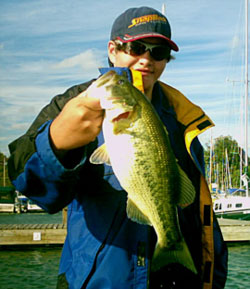 By: Richard Sims
Lake Erie is a renowned smallmouth
fishery. It is talked about and talked about how Lake Erie's smallmouth
population is so high and that people from all over the world come to chase
these big brutes. Well... I'm sick of it. Lake Erie is a great fishery
for plenty of species. Walleye, Rainbow Trout, Northern Pike and of course
jumbo yellow perch are all common game in this lake. There always seems
to be one fish left out in the cold though, as if he doesn't exist here.
His name is old bucketmouth, and I can tell you from experience... he not
only lives here... he thrives here! With the massive amounts of people
coming here for tournaments or for pure fishing pleasure, I must tell you
all about not only how great the largemouth fishing is in Lake Erie, but
also how to go about catching them consistently.
By Comparison
First of all, I am in no
way saying that the largemouth fishery in Lake Erie is better or even equal
to the smallmouth fishery. Trust me, the smallmouth fishery is in a league
of it's own. But year after year tournament limits are often won with our
old friend Mr. Largemouth in the creel. Why is this? Well, in my opinion
it's simply because largemouth here are more reliable. Think about it.
If you're fishing in 30 feet of water on a hump and the smallies stop biting,
you're left waiting for them to start biting again. It may or may not happen
that day, that week or the rest of that year! They may have left and you'd
never know about it. And if this happens in a tournament, you're out of
the picture. Luck plays a fairly large role in Lake Erie smallmouth fishing.
Now just say you're in that
same tournament fishing for largemouth in 6 feet of water, near a trough
on the right and a bunch of docks on the left. A perfect spot. You're getting
them on the edge of the trough through the weeds on a white spinnerbait
ripped through the weeds. All of the sudden your fish stop biting. Now
you have plenty of choices. You could start dropping finesse baits like
plastics into holes in the weeds. You could start fishing the docks on
the left, looking for a reaction strike. You can still catch fish throughout
the day, and you can bet that lazy old largemouth won't roam very far from
a prime feeding ground.
So largemouth are the sensible
choice in a tournament right? Well.. not necessarily. There is a big reason
why so many tournament fishermen on Lake Erie choose to target smallies.
If the fish are there, and they're biting... you've got it made. You can
scrape up a limit of 6lb+ fish in one day when you target smallies sometimes,
while largemouth's average size on a good day would be about 3lbs a piece
with the odd 6lb+ thrown in.
They both have their up-sides
and their down-sides, but in my books largemouth are the sensible choice,
since I am not a gambler. Hey, go ahead and take chances out there, that's
what tournament fishing is about! But it's also about careful planning
ahead of time and estimating if your smallmouth will be there or not. A
good strategy in the past in 2 day tournaments has been to get your decent
limit of largemouth the first day, to get yourself on or near the top,
then gambling on the second day. Whatever you choose, just remember that
old Mr. Largemouth isn't too far away.
Why Are Largemouth More
Reliable?
We've covered this a little,
but I thought I would add some more points. If you want to go chase smallmouth
on shoals in unprotected water, you need it to be relatively calm. Well,
in a tournament of course you would go out there no matter what, but I'm
sure you'd rather go the comfortable route. Plus high waves and high wind
make it very difficult to fish and detect strikes from smallmouth that
are 30ft down. Meanwhile you can go to protected bays, rivers and canals
and catch largemouth all day as though there was no wind whatsoever! That's
another reason largemouth are just the reliable choice.
Where To Start?
Now that we've covered the
why, let's start to cover the how. First of all this can change seasonally
and in some parts of Lake Erie there literally is no largemouth. First
of all, any places with large, shallow bays (i.e. Long Point Bay in Ontario,
most of the Western Basin, tributary rivers, etc.) will hold largemouth.
For the most part, Lake Erie largemouth will not venture out to water deeper
than 20 feet. In fact, the majority of Lake Erie largemouth will be found
in less than 10 feet of water. Weeds are extremely important. Make sure
the area you are fishing has weeds at certain times of the year, or some
other oxygen source, and plenty of baitfish. Also, having some deep water
access nearby is a necessity for bigger largemouth. Ledges, channels and
rivers are usually deeper areas. Wood structure tends to be less important,
but things like docks in marinas or laydowns in tributary rivers are very
good areas for Lake Erie largemouth as well.
The name of the game is finding
fairly shallow, structured, covered areas that are protected from heavy
waves. Largemouth tend to prefer a calmer setting and don't like being
bashed around by waves, although they can still be caught in rough conditions.
Marinas or channels that allow public fishing access are often good choices
for bigger bass. These usually have both wood and weed cover, and in the
colder months; some rock cover or metal docks hold heat and will draw bass
as well. Avoid any brown weeds as bigger largemouth want nothing to do
with them.
Presentations are endless
and depend on season/conditions, but there are some proven tactics for
Lake Erie largemouth that I would like to cover.
One great way of catching
big largemouth on sunny days during summer or early fall is to find blown-in
weed mats in coves or canals, and flip 7 inch plastic worms right into
them. Fish the edges of them first, but never avoid throwing your worm
(or other plastic bait) high in the air and letting it crash right down
through the middle of the mat. Or you can use holes that are naturally
in the mat and flip into them. My biggest Lake Erie largemouth have come
from this tactic, some in only inches of water!
Don't put those plastics
down just yet. The most reliable pattern for a faster limit in some Lake
Erie bays is flipping plastic baits or flippin' jigs into pockets or holes
in weed flats during the spring, summer or early fall. Make sure you have
a stout flippin' stick with heavy, abrasion resistant line (like Silver
Thread Excalibur) to be able to horse the bass out of the heavy weeds.
Weeds have very sharp edges that can cut through cheaper or weaker line
like a knife through butter. Let your bait fall right to the bottom in
these holes (texas rigs are usually best) and bounce it on bottom for a
few seconds, then pull up and find the next hole. The advantage to this
method is that you can often let the wind do the work for you and barely
touch your electric motor. If you get on the right drift you can do this
over and over again throughout the day and keep catching fish. It also
works with spinnerbaits, allowed to helicopter into holes and pockets in
the weeds.
As always, marinas are very
good places to look. They often host a variety of structure, and on the
great lakes they usually also have large breakwalls made of rip-rap or
metal. During the early hours or the late afternoon in the summer, or in
spring or fall, many times a quick limit of decent largemouth can be caught
off of these breakwalls by simply spinnerbaiting all the way down. Any
differences like bends in the wall, broken cement pieces or ladders are
obvious places to use to your advantage. Spinnerbait speed and depth depends
on the mood of the fish and the season. Vary your colors, blades and retreive
speeds until you find the one that the fish want. Often times the larger
fish on the breakwalls will smash a slightly different bait like a buzzbait
or suspending jerkbait, brought through the areas after they've been worked
over with spinnerbaits.
Of course, never overlook
the obvious. Docks, boathouses and other man-made structures inside marinas
and covers are often big bass magnets. Some favourite techniques for fishing
these areas in Lake Erie are chucking spinnerbaits underneath or around
edges of the docks, and smacking the bait into the dock legs, skipping
3 or 4 inch tube baits underneath with a light texas rig, and allowing
the bait to fall to the bottom slowly. Often the fish pick the bait up
before it hits bottom. Sometimes the simplest tactic, flipping worms &
jigs to the dock legs or into boathouses can produce the biggest of the
big largemouth in these man-made fish hideouts. Often the shade and ambush
point offered by these is too much for the bass to resist!
Overall
Lake Erie largemouth are
often overlooked in the big picture. If your dream is coming to Lake Erie
for it's monster smallies, then so be it. Just make sure you get to the
right place at the right time. If you just want a reliable fish to catch,
or a good way to get a tournament limit, largemouth are probably the way
to go. Lake Erie largemouth can be very challenging, but often you get
big rewards from chasing them bucketmouths!
As always, make sure you
stay safe out on the water, especially big water like Lake Erie. Be respectful
of other people's property, and always, always have fun out there! Good
luck & Tight Lines, |